-10%
Tomas Casas I Klett
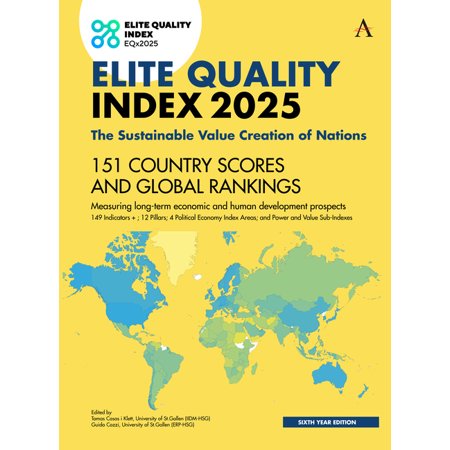
Elite Quality Index 2025: The Sustainable Value Creation of Nations (Hardcover)
$448.25
$500.00
In Stock
Walmart
View Deal at Walmart
You'll be taken to the retailer's site to complete your purchase.
BrandTomas Casas I Klett
Size[]
ConditionNew
The Elite Quality Index (EQx) proposes an analytical framework to interpret--and possibly transform--the state of elite quality in the world s political economies. It is based on a simple idea. The EQx posits that the business models chosen and run by elites determine economic and human development. That is elites (the who ) affect human and economic development outcomes (the what ) sometimes directly but mostly indirectly through the influence that they exert on the institutions (the how ) that set the rules of the game. These rules bestow on elites a license to operate. Both the how and the what have been theoretically discussed at great length and are amply measured. However the EQx focuses on the who element a research gap that urgently needs to be addressed. This is pursued at the national level by considering aggregate national elite systems in terms of the Value Creation and Value Extraction impacts of their primary business models. As a precursor of institutional quality Elite Quality is deemed to be a significant pointer to long-term economic growth. The EQx is a political economy index that uses aggregated datasets to measure the overall sustainable value creation of nations in terms of the ability of its elite business models to create value rather than extract it through rent seeking. The EQx is based on a four-level architecture. Below the top-level Index rankings there are two Sub-Indices: Power and Value. Value Sub-Index I provides direct evidence of Value Creation and Extraction by elite business models even though the latter might be easier to capture as the results of rent seeking are more visible. Power Sub-Index II conceptualizes the potential for Value Extraction as this cannot exist without power. Hence while power is not Value Extraction per se it is a necessary condition for rent seeking to take place. In many countries elites that enjoy a high degree of power invest in operating inclusive Value Creation business models while in others it is used to leverage value transfers from an array of stakeholders. Both of the EQx s two Sub-Indices have a political and an economic dimension. This conceptual 2 × 2 framework results in four Index Areas. First Political Power measures the capture of three kinds of rules: rules of the state the rules of business regulation and the rules of human labor. Second Economic Power measures elite dominance at the firm and industry levels such as measuring how much positive creative destruction there is in a political economy. Third Political Value measures Value Extraction in the political dimension; the state s unearned income its taking of income and its giving of income. Fourth Economic Value measures Value Extraction from the economy s three markets: products and services the capital markets and the labor markets. Each EQx Index Area is then assigned 3 conceptually related Pillars yielding a total of 12. The purpose of the Pillars is to define and create conceptual lenses through which we can approach understand and measure specific phenomena. At the final and fourth level are the Indicators that use datasets to operationalize political economy phenomena associated with elite agency. All individual indicators and the respective weights that they are given then flow back up the framework to provide scores at the Pillar and aggregate EQx level. Descriptions of each of the 149 indicators used (what we measure) as well as the sustainable value creation (vs. rent-seeking) rationale that underpins their inclusion in the EQx (why we measure) are included in the report. The EQx2025 provides novel insights that will allow policymakers academics journalists business leaders students and con
| Brand | Tomas Casas I Klett |
| Size | [] |
| Condition | New |
| Barcode / EAN | 9781839996429 |
| Store | Walmart |